A FIELD JOURNAL BY MARTIN MILES

A human
perspective.
An artificial
future.

Making sense of AI, one thought at a time.
The discoveries. The questions. The in-between.

Enter the stream
INDEPENDENT THOUGHTS. INFINITE CURIOSITY.EXPLORING IN PUBLIC
THE STREAM

A mind in motion.

LATEST FIRST
A working notebook, with example thoughts.

20 sourced AI stories from 2024–2025. Historical demo content, not Martin’s personal posts. Dates follow the sources.

Try the editor
Notes from the frontier
mm

Claude 4: a new generation of coding assistants

Anthropic introduced Claude Opus 4 and Claude Sonnet 4, positioning the pair around coding, reasoning, and agent workflows.

The practical question for a developer is how a model behaves across a whole task: reading a repository, making a change, running checks, and responding to feedback. A benchmark is one input, not the entire evaluation.

A day with Claude — AnthropicWatch on YouTube

This is a historical launch example, not a recommendation about today’s model lineup.

DEMO · SOURCED SUMMARYAnthropic
Open note
mm

AlphaEvolve puts generated algorithms to the test

Google DeepMind introduced AlphaEvolve, a coding agent that combines language models with automated evaluation and an evolutionary search process.

Its reported applications include data-center scheduling, chip design, and AI training. The interesting pattern is the feedback loop:

  1. Propose a candidate.
  2. Run a measurable evaluation.
  3. Keep useful improvements and iterate.

Ideas are cheap; reliable evaluation is the multiplier.

DEMO · SOURCED SUMMARYGoogle DeepMind
Open note
mm

Gemini 2.5: more thinking, more context

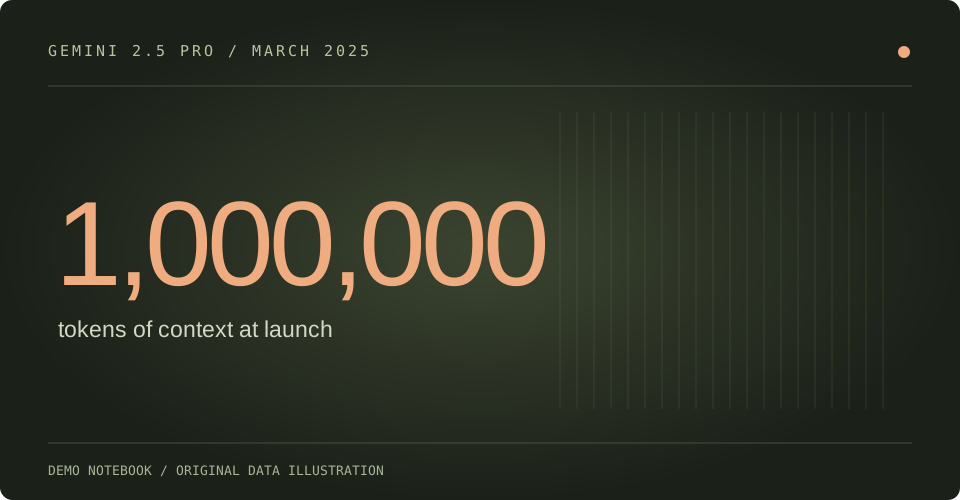
Google announced Gemini 2.5 Pro with reasoning capabilities and a 1 million-token context window at launch.

A larger window changes what can fit into a request. It does not remove the need to choose relevant material, verify citations, or measure whether the answer actually uses the supplied evidence.

Gemini 2.5 Pro launched with a context window of one million tokens.

Original explanatory graphic; data from the linked source.

Launch specification from March 2025; not a statement of current limits.

DEMO · SOURCED SUMMARYGoogle
Open note
mm

Gemma 3 makes the small-model conversation more interesting

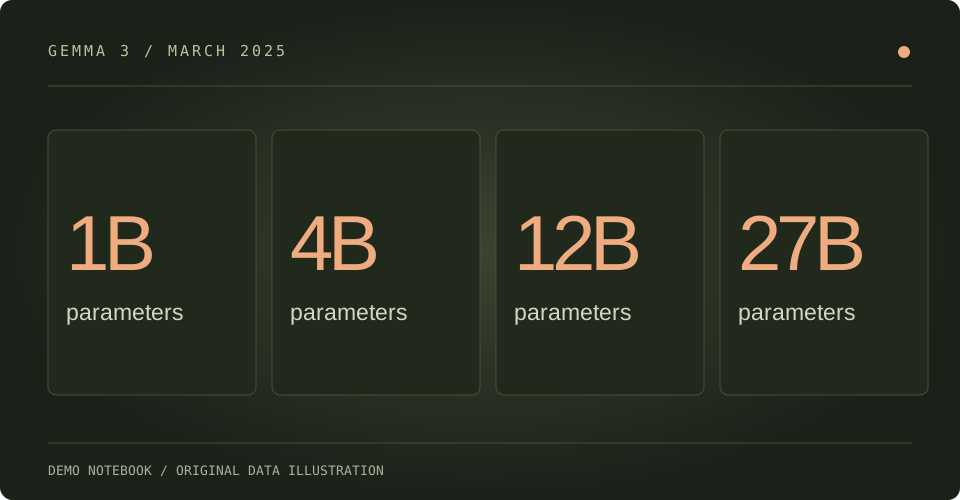
The Gemma 3 family arrived in 1B, 4B, 12B, and 27B parameter sizes. Google described multilingual support across more than 140 languages and context windows up to 128K tokens.

The specifications vary by model: the 1B variant is text-only, while the larger variants add image understanding. Always check the model card for the particular size you intend to run.

The four Gemma 3 parameter sizes: 1, 4, 12, and 27 billion.

Original explanatory graphic; data from the linked source.

DEMO · SOURCED SUMMARYGoogle Developers
Open note
mm

Claude 3.7 makes thinking time a design choice

Claude 3.7 Sonnet combined ordinary responses and an extended-thinking mode in one model. Anthropic also introduced Claude Code as a command-line coding tool.

For product design, this raises a useful question: when does the user benefit from waiting for a deeper answer, and when is a fast response enough?

Latency belongs in the evaluation alongside answer quality.

DEMO · SOURCED SUMMARYAnthropic
Open note
mm

Video understanding, in a much smaller package

Hugging Face’s SmolVLM2 release explored video understanding with models in the 2.2B, 500M, and 256M size range.

That makes a useful counterpoint to the biggest-model headlines: deployment constraints can be part of the research target, rather than something considered after training.

Read the technical details and examples →

DEMO · SOURCED SUMMARYHugging Face
Open note
mm

Mistral Small 3: 24 billion parameters, Apache 2.0

Mistral released Small 3, a 24B-parameter model under the Apache 2.0 license, with an emphasis on low-latency language tasks.

  • Model quality is one consideration.
  • Deployment cost is another.
  • License terms are part of the engineering decision too.

Pick the largest model by default.
Start with the task and evaluate what is sufficient.

DEMO · SOURCED SUMMARYMistral AI
Open note
mm

Qwen2.5-VL looks beyond the static screenshot

The Qwen2.5-VL announcement described improvements in document understanding, visual localization, and video comprehension.

These are different capabilities. Reading a chart, locating a button, and understanding a sequence of events should each have their own test cases.

The date shown here follows the publication date displayed on the linked team blog.

DEMO · SOURCED SUMMARYQwen team
Open note
mm

DeepSeek-R1 brings reasoning weights into the open

DeepSeek announced DeepSeek-R1 and released model weights alongside smaller distilled models.

Access to weights creates room for independent evaluation and deployment experiments. It does not, by itself, settle questions about robustness, training data, or suitability for a particular use case.

The release repository and technical report →

DEMO · SOURCED SUMMARYDeepSeek
Open note
mm

Gemini 2.0 turns toward the agent workflow

Google introduced Gemini 2.0, starting with an experimental Flash model and demonstrations of tool use and multimodal interaction.

The announcement framed assistants as systems that could do more than answer a single prompt. That makes permissions, observable actions, and recoverable mistakes important parts of the product.

Introducing Gemini 2.0 — GoogleWatch on YouTube
DEMO · SOURCED SUMMARYGoogle
Open note
mm

Genie 2: worlds as a training environment

DeepMind’s Genie 2 research demonstrated action-controllable 3D environments generated from a single image prompt.

Its stated purpose was to help train and evaluate embodied agents using diverse simulated environments. A research demonstration is different from a production game engine, but the direction is worth watching.

See the original interactive-world demonstrations →
DEMO · SOURCED SUMMARYGoogle DeepMind
Open note
mm

MCP: a common connection between assistants and tools

Anthropic introduced the Model Context Protocol as an open standard for connecting assistants to data sources and tools.

A shared protocol can simplify integration. It does not automatically make a connected tool safe: access control, the scope of each action, and the treatment of untrusted content still matter.

assistant → protocol → tool or data source

Small interface. Large architectural consequences.

DEMO · SOURCED SUMMARYAnthropic
Open note

The future isn’t finished.
Neither is this conversation.

Stay curious. Follow along.